Botox (Botulinum Toxin) is a non-surgical injectable treatment used to reduce the appearance of dynamic wrinkles caused by repeated facial muscle movement. It works by temporarily relaxing targeted muscles, helping smooth lines and wrinkles while also being used for certain facial contouring and medical indications. Results are temporary, with effects typically developing over several days and lasting several months.
Botox works by temporarily relaxing muscles. It blocks nerve signals to specific muscles, reducing their ability to contract and form expression lines.
Most commonly used for facial wrinkles. Popular treatment areas include forehead lines, frown lines (glabellar lines), and crow's feet around the eyes.
Results are not immediate. Initial effects often begin within a few days, with full results usually visible within 1–2 weeks.
Effects are temporary. Most patients require repeat treatments every few months to maintain results.
Treatment is minimally invasive. Sessions are typically quick and involve multiple small injections with little downtime.
Botox can also be used for facial slimming. Injection into the masseter muscles may help reduce jaw muscle prominence and create a slimmer facial appearance.
Medical applications extend beyond aesthetics. Botox may also be used for conditions such as excessive sweating, teeth grinding, muscle spasms, and chronic migraines.
Side effects are usually mild and temporary. Common effects include redness, swelling, bruising, tenderness, and temporary discomfort at the injection site.
Results depend on proper technique and patient selection. Treatment planning, dosage, anatomy, and injector experience all influence outcomes.

Botulinum toxin works at the neuromuscular junction, where nerves communicate with muscles. By reducing the signal between the nerve and the treated muscle, the muscle contracts less strongly for a temporary period.
This reduction in muscle activity can help soften expression lines caused by repeated facial movement, such as forehead lines, frown lines and crow’s feet. In larger muscles, such as the masseter, trapezius or calf muscles, reduced muscle activity over time may also help improve selected muscle-related contouring concerns.
The outcome of botulinum toxin treatment depends on accurate assessment of the muscle being treated, the strength of contraction, the number of injection points and the dosage used. Different areas of the face and body require different treatment planning because each muscle has a different function, size and relationship with surrounding structures.
For example, the forehead requires careful dosing because excessive relaxation may cause heaviness of the brows. The masseter muscles usually require a different dosage approach because they are larger chewing muscles. This is why treatment should be customised rather than performed using a fixed template.
Every patient has different muscle strength, facial proportions, asymmetry and treatment goals. A suitable treatment plan should take these factors into account so that the result looks natural and appropriate for the individual.
A doctor-led consultation is important because botulinum toxin treatment involves both aesthetic judgement and anatomical precision. The aim is not simply to weaken muscles, but to reduce unwanted overactivity while preserving normal expression, balance and function where possible.

Botulinum toxin treatment can be customised for different facial and body concerns depending on the muscle involved, the strength of contraction and the desired outcome. In Singapore, common treatment areas include expression lines, facial slimming, jaw clenching, shoulder slimming, calf slimming and excessive sweating.
This section gives an overview of the main treatment areas. For more detailed information on each concern, you may refer to the dedicated treatment pages listed below.
Forehead lines are horizontal expression lines that appear when the frontalis muscle contracts during eyebrow raising. Treatment in this area aims to soften forehead wrinkles while preserving natural brow movement and facial expression.
Because the forehead muscle also helps lift the brows, dosage and injection placement must be planned carefully. Excessive relaxation may lead to brow heaviness in some patients, especially if there is pre-existing eyelid or brow laxity.
Forehead wrinkle-relaxing treatment:
https://botoxsingapore.sg/forehead-botox-singapore/
Frown lines, also known as glabellar lines, develop from repeated contraction of the muscles between the eyebrows. These lines may become more visible when a person frowns, concentrates or squints.
Botulinum toxin treatment for frown lines aims to reduce overactivity in the glabella complex, helping the area between the eyebrows appear softer and less tense while maintaining a natural appearance.
Frown line treatment:
https://botoxsingapore.sg/frown-botox-singapore/
Crow’s feet are fine lines that appear at the outer corners of the eyes, especially during smiling or squinting. They are commonly caused by repeated contraction of the orbicularis oculi muscle around the eyes.
Treatment can help soften these dynamic eye wrinkles while preserving a natural smile. Careful placement is important because the eye area is delicate and closely related to cheek movement, lower eyelid support and facial expression.
Crow’s feet treatment:
https://botoxsingapore.sg/crows-feet-botox-singapore/
A non-surgical brow lift treatment uses carefully selected injection points to reduce the activity of muscles that pull the brows downward. In suitable patients, this may help create a subtle lifting effect around the brows and upper eyelid area.
This treatment is usually planned based on brow shape, forehead muscle activity, eyelid heaviness and facial balance. It is not a replacement for surgical lifting, but may be suitable for patients seeking a mild, non-surgical improvement.
Brow lift treatment:
https://botoxsingapore.sg/brow-lift-botox-singapore/
Jaw slimming treatment targets the masseter muscles, which are the main chewing muscles located at the sides of the jaw. These muscles may become enlarged due to genetics, frequent chewing, jaw clenching or teeth grinding.
Reducing masseter muscle activity can help create a slimmer lower-face contour in suitable patients. It may also help patients with muscle-related jaw tension or clenching, depending on the underlying cause and assessment findings.
Jaw slimming and masseter reduction treatment:
https://botoxsingapore.sg/jaw-botox-singapore/
Shoulder slimming treatment targets the trapezius muscles, which extend from the neck to the shoulders and upper back. In some patients, enlarged or overactive trapezius muscles can contribute to a bulky shoulder appearance or a shorter-looking neck.
Botulinum toxin treatment may help reduce trapezius muscle activity in selected patients, creating a softer shoulder contour and a more elongated neck-and-shoulder line over time. Suitability depends on whether the shoulder bulk is mainly muscle-related.
Shoulder slimming and trapezius reduction treatment:
https://botoxsingapore.sg/shoulder-slimming-trapezius-botox-singapore/
Calf slimming treatment targets selected calf muscles in patients whose calf size is mainly due to muscle bulk. This may be considered for patients who feel their calves appear bulky despite having relatively low fat in the area.
Treatment planning depends on the shape of the calf, muscle distribution, walking function and desired degree of slimming. It is important to distinguish muscle bulk from fat, swelling or structural leg shape before deciding whether this treatment is suitable.
Calf slimming treatment:
https://botoxsingapore.sg/calf-slimming-botox-singapore/
Botulinum toxin can also be used for excessive underarm sweating, also known as axillary hyperhidrosis. Instead of targeting facial movement or muscle contour, treatment in this area works by temporarily reducing stimulation of the sweat glands.
This may be suitable for patients who experience persistent underarm sweating that affects clothing choices, confidence, comfort or daily activities.
Excessive underarm sweating treatment:
https://botoxsingapore.sg/sweaty-underarms-botox-singapore/
Selected lower-face and neck injection points may help reduce downward-pulling muscle activity in suitable patients. This can support better jawline definition and improve the appearance of mild neck banding or lower-face tension.
Treatment in this area requires careful assessment because the neck and jawline involve multiple muscles that affect expression, swallowing, facial balance and lower-face support.
Neck lift and jawline treatment:
https://botoxsingapore.sg/neck-lift-jawline-botox-singapore/

Botulinum toxin treatment may be suitable for patients who have concerns related to repeated muscle movement, overactive muscles, muscle-related facial contouring or excessive sweating. Suitability depends on the treatment area, muscle strength, medical history, expectations and whether the concern can be safely improved with a muscle-relaxing injectable treatment.
Patients with dynamic expression lines may be suitable for botulinum toxin treatment if their lines are mainly caused by repeated muscle movement. Common examples include forehead lines from raising the eyebrows, frown lines from squeezing the brows together and crow’s feet from smiling or squinting.
These lines usually appear more clearly during facial movement. Over time, repeated folding of the skin may cause the lines to become visible even at rest. Treatment is often more effective when dynamic muscle movement is a major contributor to the concern.
Some patients have stronger facial muscle activity that contributes to a tense, tired or aged appearance. For example, frequent frowning may make the area between the eyebrows look heavy or stern, while repeated forehead movement may make horizontal forehead lines more noticeable.
Botulinum toxin treatment may help reduce excessive muscle contraction in selected areas while still allowing natural facial expression. The aim is to soften overactivity, not to completely remove normal movement.
Botulinum toxin treatment may also be suitable for patients whose facial or body contour concerns are partly caused by muscle bulk. Examples include enlarged masseter muscles contributing to a wider lower face, prominent trapezius muscles contributing to shoulder bulk or selected calf muscles contributing to bulky-looking calves.
A proper assessment is important because not all contouring concerns are muscle-related. If the concern is mainly due to bone structure, fat, skin laxity or fluid retention, other treatment options may be more appropriate.
Patients with jaw clenching, teeth grinding or masseter muscle tension may be suitable for treatment if the masseter muscles are overactive or enlarged. Treatment aims to reduce the strength of masseter contraction, which may help improve muscle-related jaw tension in selected patients.
However, jaw discomfort can have different causes, including dental issues, temporomandibular joint problems and bite-related concerns. A medical or dental assessment may be needed if symptoms are persistent, painful or associated with joint clicking, locking or significant discomfort.
Patients with excessive underarm sweating may be suitable for botulinum toxin treatment if sweating affects daily comfort, clothing choices, confidence or quality of life. Treatment works by temporarily reducing stimulation of the sweat glands in the treated area.
Suitability depends on the severity of sweating, previous treatments tried, medical history and whether there are any underlying causes that should be assessed first.
Botulinum toxin treatment may be suitable for patients who prefer a non-surgical option with minimal downtime. Most patients can return to normal daily activities soon after treatment, although specific aftercare instructions should still be followed.
This treatment may be appropriate for patients who want gradual, natural-looking improvement without surgery, provided their concerns are suitable for a muscle-relaxing injectable approach.

A botulinum toxin consultation allows the doctor to assess whether the concern is suitable for muscle-relaxing injectable treatment. This is especially important because different patients may have similar-looking concerns caused by different underlying factors, such as muscle activity, skin laxity, volume loss, fat, bone structure or asymmetry.
During the consultation, the doctor will assess the treatment area both at rest and during movement. For facial lines, this may involve checking how the forehead, frown muscles, eye area, brows, jawline and lower face move during expression.
For contouring concerns, the doctor may assess whether the concern is mainly related to muscle bulk. For example, a wider lower face may be due to enlarged masseter muscles, but it may also be influenced by bone structure, facial fat or overall facial proportions.
Your treatment goals are discussed before deciding on a treatment plan. Some patients prefer a very natural softening of lines, while others may want stronger reduction of muscle activity in selected areas.
For facial treatments, the goal is usually to soften unwanted lines while preserving natural expression. For muscle-related contouring treatments, the goal is to reduce selected muscle activity gradually while maintaining function and balance.
Dosage and injection points are planned based on the muscle involved, muscle strength, treatment area, facial anatomy and desired outcome. A smaller facial muscle usually requires a different dosage approach compared with larger muscles such as the masseter, trapezius or calf muscles.
This is why treatment should not be performed using a fixed template. Careful planning helps reduce the risk of over-treatment, asymmetry, heaviness or unnatural-looking results.
Not every wrinkle, contouring concern or sweating concern is best treated with botulinum toxin. Static wrinkles, skin laxity, volume loss, pigmentation, acne scars or textural concerns may require different treatments such as lasers, skinboosters, collagen-stimulating treatments, dermal fillers or energy-based lifting treatments.
A consultation helps determine whether botulinum toxin is suitable on its own or whether another treatment may be more appropriate.

A botulinum toxin treatment session is usually quick and performed in-clinic after a doctor’s consultation. The exact treatment process depends on the area treated, the number of injection points required and the personalised dosage plan.
Before treatment, the doctor will confirm the treatment areas, review the planned injection points and ensure that there are no contraindications. The skin is cleaned thoroughly before the injections are performed.
For facial treatments, patients may be asked to make certain facial expressions, such as raising the eyebrows, frowning or smiling. This allows the doctor to identify the active muscles more accurately before placing the injections.
Botulinum toxin is injected into selected muscles using a fine needle. Most patients describe the sensation as brief and tolerable, with only mild discomfort during the injection.
The number of injection points depends on the treatment area. Smaller areas such as frown lines or crow’s feet usually require fewer injection points, while larger muscle groups such as the masseter, trapezius or calf muscles may require more detailed placement and higher total dosage.
After treatment, there may be mild redness, small bumps, pin-point marks or slight tenderness at the injection sites. These usually settle within a short period.
Patients are usually able to return to normal daily activities after treatment. However, aftercare instructions should be followed carefully to reduce the risk of bruising, unnecessary pressure on the treated areas or unintended spread of the product.
For more detailed aftercare instructions, please refer to:
https://botoxsingapore.sg/botox-aftercare-guide-singapore/

Botulinum toxin treatment does not usually produce immediate results. The effect develops gradually as the treated muscles become less active over the days following treatment. The timeline can vary depending on the treatment area, dosage, muscle strength and individual response.
Some patients may start to notice early changes within a few days after treatment. For facial expression lines, this may feel like reduced strength when raising the brows, frowning or smiling.
At this stage, the results are still developing. It is normal for the treated area to continue changing gradually over the first one to two weeks.
For most facial wrinkle-relaxing treatments, results are usually assessed around two weeks after treatment. This is when the effect is closer to its peak and the doctor can better assess symmetry, muscle response and whether any adjustment is needed.
This is also why review appointments, if required, are usually arranged after sufficient time has passed for the treatment effect to stabilise.
Larger muscle treatments, such as masseter reduction, trapezius reduction and calf slimming, may take longer to show visible contouring changes. Although muscle activity may reduce earlier, visible slimming usually depends on gradual reduction in muscle bulk over time.
For example, lower-face slimming from masseter reduction may become more noticeable over several weeks, while shoulder or calf slimming may require a longer period before the contour change becomes more visible.
Results can vary depending on muscle size, muscle strength, dosage, previous treatment history, metabolism, facial anatomy and how actively the treated muscle is used. Some patients may respond strongly to a conservative dose, while others may require a different dosage plan in future sessions.
A personalised treatment plan helps balance effectiveness, safety and natural-looking results rather than aiming for excessive muscle weakening.
The duration of botulinum toxin treatment varies between patients and treatment areas. In general, the effect is temporary and gradually wears off as nerve-to-muscle communication recovers over time. Maintenance treatment may be needed if a patient wishes to sustain the results.
For facial expression lines such as forehead lines, frown lines and crow’s feet, results commonly last around three to four months. Some patients may notice that movement gradually returns earlier, while others may maintain a softer appearance for longer.
Duration can depend on the dosage used, strength of the treated muscles, facial expression habits, metabolism and previous treatment history.
Larger muscle treatments, such as masseter reduction, trapezius reduction and calf slimming, may have a different treatment timeline. While muscle activity may reduce within the first few weeks, visible contouring changes usually develop more gradually.
For these larger muscles, repeat sessions may be recommended depending on the muscle size, response to treatment and desired degree of contouring. The treatment plan should be reviewed individually rather than based on a fixed schedule.
Some patients may find that results wear off faster due to stronger muscle activity, higher baseline muscle bulk, frequent use of the treated muscles, faster metabolism or a conservative starting dose.
For example, patients who clench their jaw frequently may notice earlier return of masseter muscle activity. Patients with very strong frown or forehead muscles may also require careful dose adjustment during future sessions.
The ideal treatment interval depends on the area treated, response to treatment and personal goals. Facial wrinkle-relaxing treatments are commonly repeated when muscle movement has gradually returned and lines become more visible again.
For larger muscle or sweating-related treatments, the repeat interval may differ. A doctor’s review helps determine whether maintenance treatment is appropriate and whether the dosage or injection points should be adjusted.
Botulinum toxin treatment is generally well tolerated when performed with appropriate patient selection, accurate injection technique and suitable dosing. However, as with any injectable treatment, side effects and risks can occur. A proper consultation and doctor-led treatment planning are important to reduce the risk of complications and unnatural-looking results.
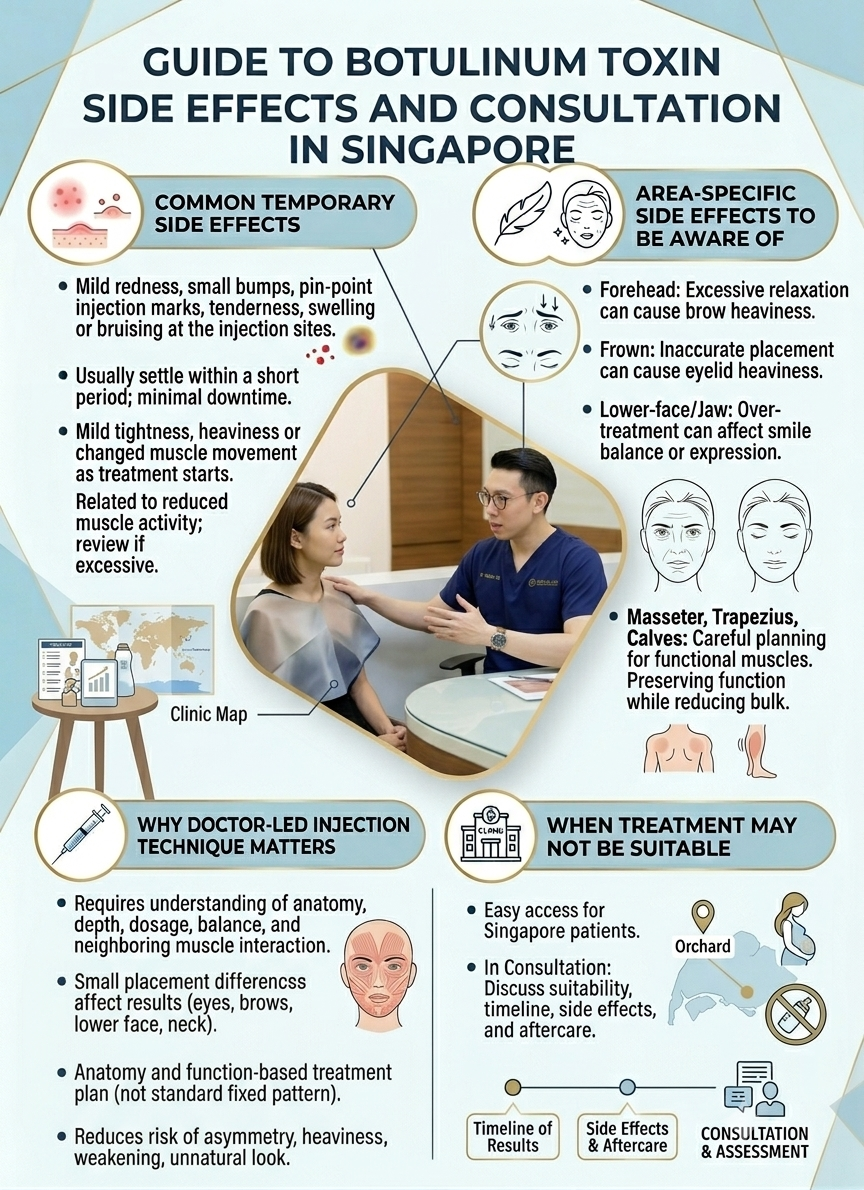
The cost of botulinum toxin treatment in Singapore varies depending on the treatment area, number of muscles treated, dosage required, complexity of the injection plan and whether the treatment is performed for facial lines, facial slimming, body contouring or excessive sweating. A doctor’s assessment is needed to determine the appropriate dose and treatment approach.
Different treatment areas require different levels of planning and product dosage. Smaller facial areas, such as frown lines or crow’s feet, usually involve fewer injection points compared with larger muscle areas such as the masseter, trapezius or calf muscles.
The cost may therefore differ depending on whether the treatment is for expression lines, jaw slimming, shoulder slimming, calf slimming or excessive underarm sweating.
Botulinum toxin treatment is commonly planned according to the number of units required for the target muscle. The required dosage depends on muscle size, muscle strength, treatment goals, previous treatment history and the desired degree of muscle relaxation.
For example, a patient with stronger masseter muscles may require a different dose compared with someone with milder muscle activity. Similarly, larger body muscles usually require a different dosage approach compared with smaller facial muscles.
For more information on dosage planning, please refer to:
https://botoxsingapore.sg/blog/how-much-botox-is-needed-guide-to-botox-dosage/
Larger muscles such as the masseter, trapezius and calf muscles generally require a higher total dosage than smaller facial muscles. This is because the treatment needs to reduce activity across a larger muscle area while maintaining safety and function.
The appropriate dose should be personalised rather than chosen based only on the treatment name. Careful assessment helps balance visible results, natural movement, safety and cost-effectiveness.
A consultation allows the doctor to assess the treatment area, muscle strength, facial or body anatomy, treatment goals and whether botulinum toxin is suitable. After assessment, the clinic can advise on the recommended treatment plan and estimated cost.
Patients should avoid choosing treatment based only on the lowest advertised price, as dosage, dilution, injector experience, assessment quality and aftercare can all affect the overall safety and outcome.

Choosing the right clinic for botulinum toxin treatment is important because the outcome depends on proper assessment, accurate injection placement, appropriate dosage and a clear understanding of facial or body anatomy. A good treatment plan should be personalised rather than based only on a standard set of injection points.
Botulinum toxin treatment requires a detailed understanding of how different muscles affect facial expression, symmetry, brow position, smile movement, jawline shape and neck balance. This is especially important for areas such as the forehead, frown lines, crow’s feet, lower face and neck.
A doctor-led approach helps ensure that treatment is planned based on anatomy, muscle strength and functional movement rather than a one-size-fits-all pattern.
Patients may have similar-looking concerns but different underlying causes. For example, forehead lines may be related to strong forehead muscle movement, brow heaviness, eyelid laxity or compensation from the upper eyelids. A wide lower face may be due to masseter muscle bulk, bone structure, facial fat or overall facial proportions.
A personalised assessment helps determine whether botulinum toxin is the right treatment and how it should be placed safely.
The goal of treatment should be to reduce unwanted muscle activity while preserving natural expression, balance and function. Over-treatment can lead to heaviness, stiffness, asymmetry or an unnatural appearance.
A careful treatment plan should consider both the desired cosmetic outcome and the practical function of the treated muscle, especially for areas such as the jaw, neck, shoulders and calves.
Good aftercare is important after injectable treatment. Patients should receive clear guidance on what to avoid after treatment, when results are expected to appear, what side effects to monitor and when to return for review if needed.
For more detailed post-treatment advice, please refer to the aftercare guide:
https://botoxsingapore.sg/botox-aftercare-guide-singapore/
Botulinum toxin treatment should not make the face look stiff, expressionless or unnatural when it is planned carefully. The aim is usually to soften unwanted muscle activity while preserving natural facial movement, balance and expression.
A frozen appearance is more likely to occur when the dosage is too high, too many areas are treated aggressively, or injections are placed without considering how facial muscles work together. This is why assessment, dosage planning and injection technique are important.
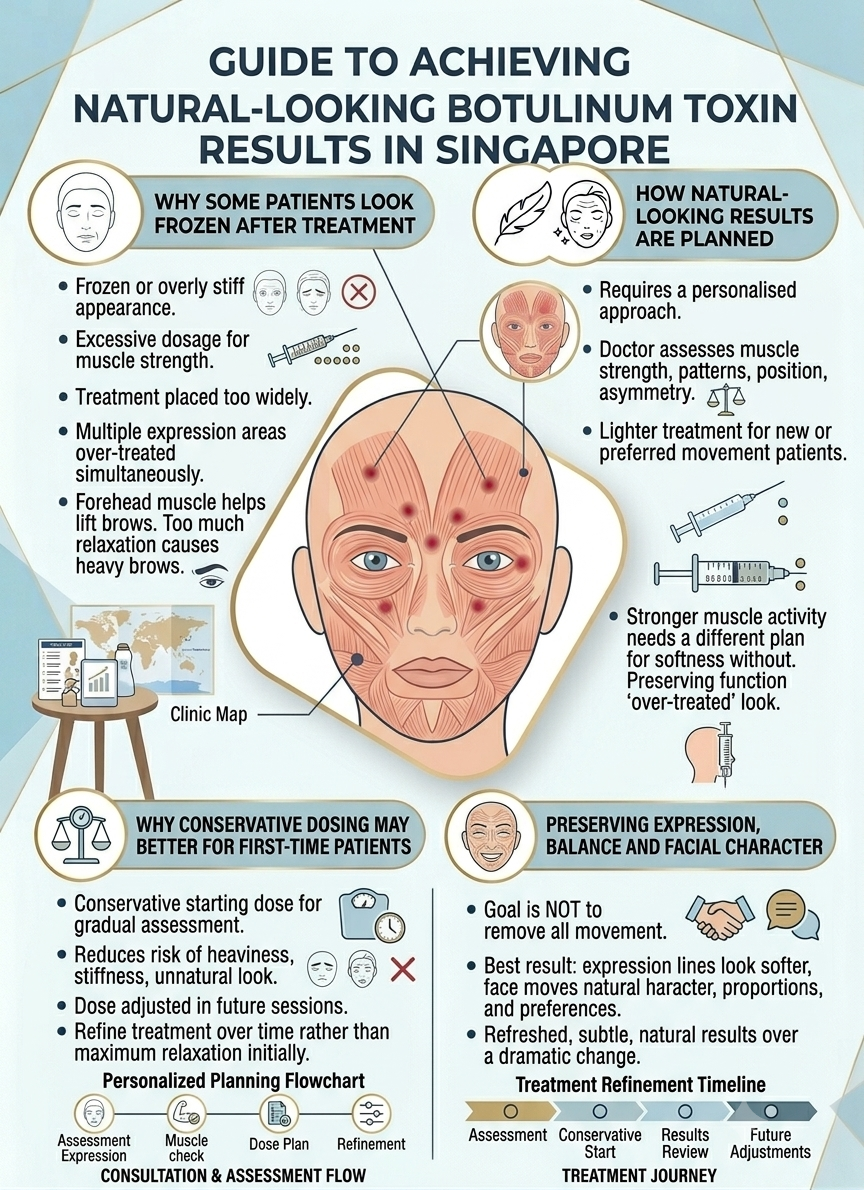
Botulinum toxin treatment can sometimes be combined with other aesthetic treatments when different concerns are present. This is because dynamic wrinkles, facial volume loss, skin laxity, pigmentation, acne scars and skin texture changes are caused by different underlying factors and may require different treatment approaches.
Combination treatment should be planned carefully after a doctor’s assessment. The aim is to choose treatments that complement each other while maintaining natural-looking results, facial balance and safety.
Botulinum toxin and dermal fillers treat different types of concerns. Botulinum toxin is mainly used to reduce selected muscle activity, while dermal fillers are commonly used to restore volume, improve facial contours and support areas affected by volume loss.
For example, expression lines may improve with muscle-relaxing injectable treatment, while deeper folds, facial hollowness or contour deficiencies may require filler-based correction. A doctor’s assessment helps determine whether the concern is mainly caused by muscle movement, volume loss, skin laxity or a combination of factors.
Dermal face fillers in Singapore:
https://botoxsingapore.sg/dermal-face-fillers-singapore/
Skinboosters and collagen-stimulating treatments may be considered when concerns involve skin hydration, skin texture, fine lines, mild skin laxity or overall skin quality. These treatments work differently from botulinum toxin, which targets muscle activity rather than skin repair, hydration or collagen stimulation.
In selected patients, botulinum toxin may be used to soften expression-related lines, while polynucleotide injectables, hybrid PDLLA + HA collagen skinboosters or HA-based skinboosters may help improve skin quality, texture, hydration and firmness. Treatment sequencing should be planned based on the patient’s skin condition, treatment goals and downtime preferences.
Polynucleotide skin rejuvenation treatment:
https://botoxsingapore.sg/rejuran-healer-singapore/
Hybrid PDLLA + HA collagen skinbooster:
https://botoxsingapore.sg/juvelook-collagen-skinbooster-singapore/
HA-based skinbooster treatment:
https://botoxsingapore.sg/skinboosters-redensity-1-singapore/
Energy-based treatments such as HIFU and lasers may be considered for concerns such as skin laxity, facial lifting, pigmentation, redness, acne scars or skin rejuvenation. These treatments work differently from botulinum toxin because they target skin quality, collagen remodelling, pigmentation or tissue tightening rather than muscle activity.
Botulinum toxin targets selected muscle activity, while HIFU is commonly used for non-surgical lifting and tightening. Lasers may be used for concerns such as pigmentation, pores, acne scars, redness or uneven skin texture. A combined approach may be suitable when patients have more than one concern, but treatment timing and sequencing should be individualised after a doctor’s assessment.
HIFU treatment in Singapore:
https://botoxsingapore.sg/hifu-non-surgical-facelift-singapore/
Pigmentation and laser treatment in Singapore:
https://botoxsingapore.sg/pigmentation-treatment-in-singapore/
Combination treatment should not be performed simply by adding multiple procedures together. Each treatment should have a clear purpose, and the doctor should consider anatomy, recovery time, treatment sequence, expected results and safety.
A personalised plan helps avoid over-treatment and ensures that each treatment addresses the correct underlying cause. This is especially important for patients who want natural-looking rejuvenation rather than an overdone or unnatural result.

At Edwin Lim Medical Aesthetic Clinic, botulinum toxin treatment is performed with a doctor-led, anatomy-based approach. The aim is to reduce unwanted muscle activity while preserving natural facial expression, balance and function where possible.
Each treatment plan is customised based on the patient’s concerns, muscle strength, facial anatomy, previous treatment history and desired outcome. This is especially important because the same treatment area may require different injection points or dosage depending on the individual.
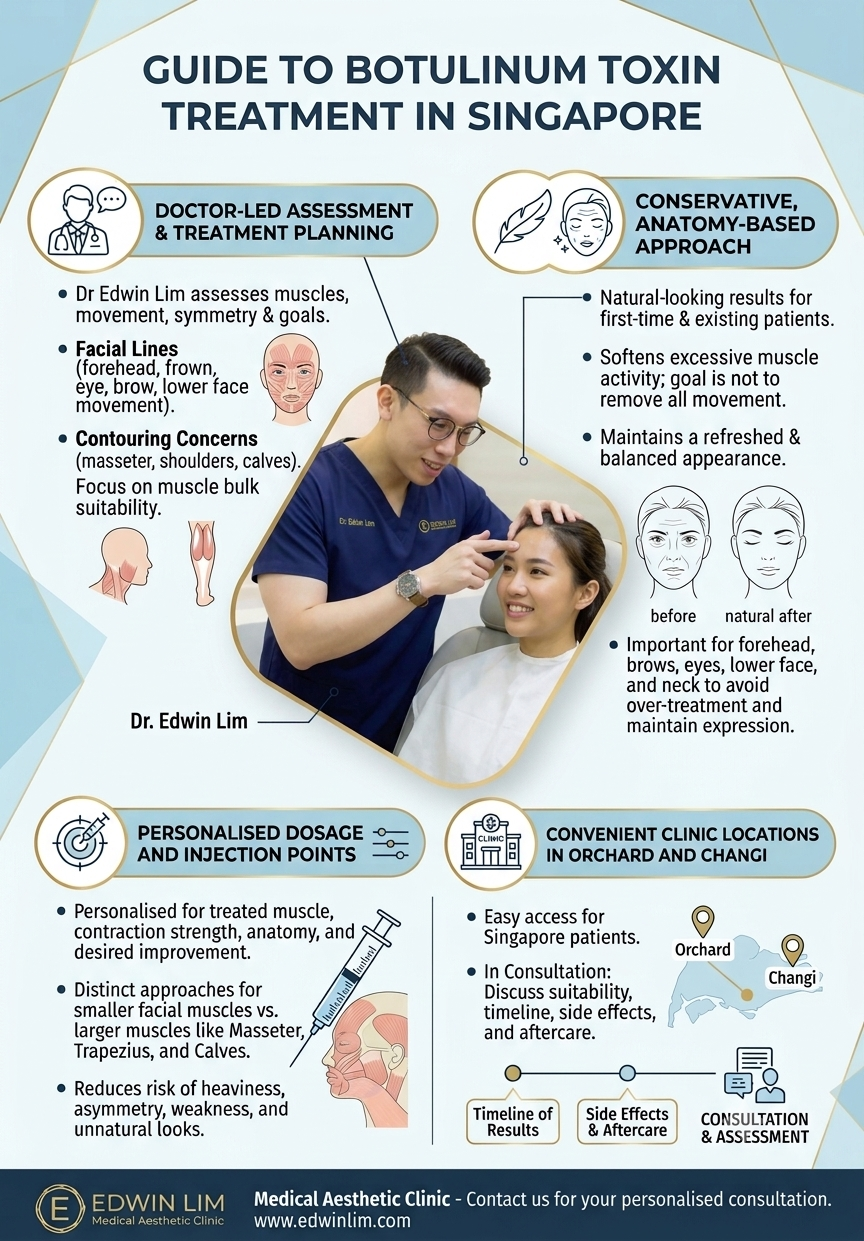
Botulinum toxin treatment is commonly searched by patients who want to understand safety, results, downtime, cost, treatment areas, dosage and product differences before deciding whether to proceed. The FAQs below address common questions patients may have before consultation.
Is Botulinum Toxin Treatment Safe?
Botulinum toxin treatment is generally well tolerated when performed with appropriate patient selection, accurate injection technique and suitable dosing. However, as with any injectable treatment, side effects and risks can occur.
Safety depends on factors such as the treatment area, dosage, injection points, medical history and the experience of the doctor performing the treatment. A consultation is important to assess suitability and reduce the risk of complications such as heaviness, asymmetry, excessive weakening or unnatural-looking results.
Is Botulinum Toxin Treatment Painful?
Most patients find botulinum toxin treatment tolerable. The injections are usually performed using a fine needle, and discomfort is typically brief.
Sensitivity can vary depending on the treatment area and individual pain tolerance. Smaller facial areas usually involve quick injections, while larger muscle areas such as the masseter, trapezius or calves may require more injection points.
Will My Face Look Frozen After Treatment?
Botulinum toxin treatment should not make the face look frozen when it is planned carefully. The aim is usually to soften excessive muscle activity while preserving natural facial expression.
A frozen appearance is more likely when the dose is too high, injection placement is unsuitable, or too many expression areas are treated too aggressively. A conservative, anatomy-based approach can help maintain natural-looking movement and facial balance.
What Is The Best Age To Start Botulinum Toxin Treatment?
There is no single best age to start botulinum toxin treatment. Suitability depends more on the patient’s concerns, muscle activity, skin condition, facial anatomy and treatment goals rather than age alone.
Some patients consider treatment when dynamic expression lines become more noticeable during movement, while others seek treatment for jaw clenching, facial slimming, shoulder slimming, calf slimming or excessive sweating. A doctor’s assessment is needed to decide whether treatment is appropriate.
How Many Units Of Botulinum Toxin Do I Need?
The number of units required depends on the treatment area, muscle size, muscle strength, desired result and previous response to treatment. Smaller facial areas usually require fewer units than larger muscles such as the masseter, trapezius or calves.
Treatment should be personalised rather than based on a fixed number of units for every patient. For more information on dosage planning, please refer to:
Botulinum toxin dosage guide:
https://botoxsingapore.sg/blog/how-much-botox-is-needed-guide-to-botox-dosage/
How Long Does Botulinum Toxin Take To Work?
Botulinum toxin treatment usually starts to take effect gradually over the first few days. For facial expression lines, results are commonly assessed around two weeks after treatment, when the effect is closer to its peak.
Larger muscle treatments such as masseter reduction, trapezius reduction and calf slimming may take longer to show visible contouring changes because muscle bulk reduces gradually over time.
How Long Do Results Usually Last?
For facial wrinkle-relaxing treatments, results commonly last around three to four months, although this varies between patients. Larger muscle treatments and sweating-related treatments may have different timelines depending on dosage, muscle size and individual response.
Results gradually wear off as nerve-to-muscle communication recovers. Maintenance treatment may be considered if the patient wishes to sustain the effect.
Can Botulinum Toxin Help With Jaw Clenching?
Botulinum toxin may help selected patients with jaw clenching if the masseter muscles are overactive or enlarged. Treatment aims to reduce the strength of masseter contraction, which may help reduce muscle-related jaw tension in suitable patients.
However, jaw discomfort can have different causes, including dental issues, temporomandibular joint concerns and bite-related problems. Persistent or painful symptoms should be properly assessed.
Jaw slimming and masseter reduction treatment:
https://botoxsingapore.sg/jaw-botox-singapore/
Can Botulinum Toxin Slim The Face?
Botulinum toxin may help slim the lower face in suitable patients if facial width is partly caused by enlarged masseter muscles. By reducing masseter muscle activity, the muscle bulk may gradually reduce over time, creating a softer lower-face contour.
This treatment is not suitable for every type of wide face. If facial width is mainly due to bone structure, facial fat or skin laxity, other treatment options may be more appropriate.
Jaw slimming and masseter reduction treatment:
https://botoxsingapore.sg/jaw-botox-singapore/
Can Botulinum Toxin Be Used For Excessive Sweating?
Yes, botulinum toxin can be used for excessive sweating in selected areas, such as the underarms. It works by temporarily reducing stimulation of the sweat glands in the treated area.
This may be suitable for patients whose underarm sweating affects clothing choices, confidence, comfort or daily activities.
Excessive underarm sweating treatment:
https://botoxsingapore.sg/sweaty-underarms-botox-singapore/
Are There Different Types Of Botulinum Toxin Used In Singapore?
Yes. There are different botulinum toxin products used in medical aesthetics. Commonly known examples include Botox, Dysport and Xeomin.
These products may differ in formulation, onset, diffusion profile and unit conversion. However, the choice of product should be based on a doctor’s assessment, treatment area, dosage planning, previous response, medical history and safety considerations.
Patients should avoid choosing treatment based only on brand name. Whether Botox, Dysport, Xeomin or another botulinum toxin product is used, important factors include accurate diagnosis, correct injection placement, suitable dosing and individual suitability.
Dysport guide:
https://botoxsingapore.sg/dysport-guide-singapore/
Xeomin guide:
https://botoxsingapore.sg/xeomin-singapore-guide/
Can Botulinum Toxin Be Combined With Fillers Or Skinboosters?
Yes, botulinum toxin can sometimes be combined with dermal fillers, skinboosters, collagen-stimulating treatments, HIFU or lasers when different concerns are present. Each treatment works differently and should be chosen based on the underlying cause of the concern.
For example, botulinum toxin may be used to reduce expression-related muscle activity, while dermal fillers may help restore volume or support facial contours. Skinboosters and collagen-stimulating treatments may be considered for hydration, texture, fine lines or overall skin quality.
Combination treatment should be planned carefully to avoid over-treatment and to maintain natural-looking results, balance and safety.
What Should I Avoid After Botulinum Toxin Treatment?
Patients are usually advised to avoid rubbing, massaging or applying firm pressure to the treated areas for the first few hours after treatment. Depending on the area treated, patients may also be advised to avoid strenuous exercise, alcohol, facial massage, facial treatments, saunas and heat-based activities during the initial recovery period.
For more detailed post-treatment instructions, please refer to:
Botulinum toxin aftercare guide:
https://botoxsingapore.sg/botox-aftercare-guide-singapore/
What Happens If I Stop Botulinum Toxin Treatment?
If treatment is stopped, the effects will gradually wear off as muscle activity returns. Expression lines or muscle-related concerns may slowly become more noticeable again over time, depending on the area treated and the patient’s baseline muscle activity.
Stopping treatment does not usually make the muscles worse than before. The treated area generally returns gradually towards its original pattern of movement.

Copyrights 2026 by Edwin Lim Medical Aesthetic Clinic Pte. Ltd.


